
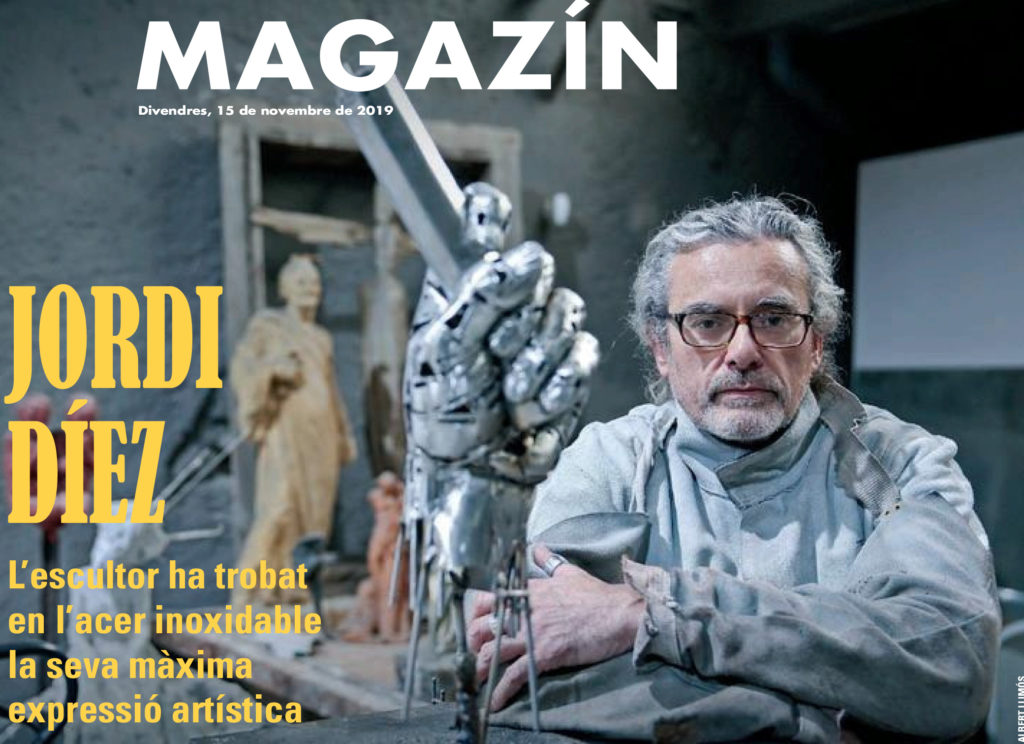
Article published in Magazín
At the edge of the 1,000 meters high Puigsagordi, Jordi Díez finds the necessary inspiration to transform his ideas into art. The sculptor born in Valladolid who has lived between Barcelona -where he spent his childhood- and Madrid -where he studied Fine Arts- about twenty years ago he decided to settle in Osona. Here he has consolidated an artistic career that has taken his works to museums, galleries and public spaces all over the world, with a permanent presence in cultures as different as Thailand, Saudi Arabia or the United States, where he has just received his latest assignment.
Just as his work plays with opposing effects, his life has always been a duality between the urban and rural world. “When I arrived in Barcelona I spent three years in the Barceloneta because it fascinated me. Em tornava boig perquè venia precisament de I lived near l’Escorial in a house lost there and needed the city” until “After three years, I’ve had enough for a lifetime” and it’s going to be to install Centelles in what has become “a path of no return”, because it has “ara quan vaig a la ciutat em sembla excessivament trepidant per mi. Al camp, a the mountain is like the pulse of the earth is essential”.
Wrapped in woodland, Díez has discovered his creative universe: “Nature inspires me in an abstract way, you are much more aware of the cycle of the seasons, of everything, of the night and the day, of the heat and cold” and it is at this time of the year when “cold activates me, m’inspira. Cold is pure and hard sculptural energy”. Especially for “als sculptors of my type, that we work with material, which is a hard and difficult work. you arrive home very tired”.
Starting from a training traditional, Díez has always been a figurative artist that has worked with all the possible materials in his sculptures. “My reference is Miquel Àngel and I have sculpted a lot of stone”, as the minimalist figure of the saint, barefoot and pointing at the sky, which crowns the doorway of the church of Sant Hipòlit de Voltregà since the rehabilitation was completed in 2006. The terracotta or bronze foundry are some of the other materials with which we use expressed himself until he realized that the sculpture was there, in the large structures that subjected the works that he had to fund.
It is the moment that gives a his career to experiment with stainless steel, a material that has been used for many years. hard and resistant for a work that generally is located outdoors but that alhora li dona una aparença de modernitat. “Estem al segle XXI i l’art ha de to be representative of its time. It is possible to know the history of mankind knowing the history of its art, how an ancient civilization was through its art”. and from this approach “I started to investigate with another one llenguatge”. First it will do it with iron, playing with several rovellades that “I also found it aesthetically obsolete” until, as a consequence of this The work will arrive at the steel with the premise of maintaining a career “of a volitionally, to keep myself away from tendencies or to allow them to come in. the right information so as not to be contaminated by other references”.
It is in this search for new artistic expressions that “are beginning to take on great importance the inside of the sculpture, not only the outside, and this brings out the lleugeresa” that irradiates his creations. “L’acer, as it lacks color, in reality, he started to give me some shades that he could not give me any other. material”, among them that the light crosses the work “and at times it seems that estic fent una cosa com amb no matèria”.
This immateriality will to start working with the floating sculptures, held by steel cables. “En el fons és com que no busco representar una cosa sinó el que anima aquesta. thing, as its inner spectacle, the energy”. Although his works figurative or with natural elements – such as a rose that is embedded in a façade of Centelles- part of the encàrrecs, he also lets himself be carried away by his own own impulses and creates spontaneously because “ideas follow one another, have a peak of intensity and if you don’t pay attention it starts to decay. Sometimes you want to reprimand them and you no longer understand what was encouraging you”. One of these works spontaneous will be a tribute to Lita Cabellut, renowned but little known at the same time painter born in Barcelona who lives in La Haia. “Quan vaig entrar en contacte with his work I was moved. Em vaig posar en contacte amb ella i li vaig dir que anava a fer una versió d’acer d’un dels seus quadres i em va dir I’m delighted.” From this project, conversations have already begun to consolidate a new creative line versioning other pictorial works in steel.
The multiple readings of Ildefons Cerdà
One of the most important works Jordi Díez’s emblematic works is the one dedicated to Ildefons Cerdà, which crowns the traffic circle located at the end of the avenue that bears his name in Centelles. Inaugurated for the main celebration of 2010, when it will receive this encàrrec of the Diputació de Barcelona to commemorate the Cerdà Year on the occasion of the 150th anniversary of the approval of the planning of the Eixample de Barcelona, Díez knew him well. little thing, of the most illustrious centellenc. That is how he began to read the his General Theory of Urbanization for the immersing himself in the figure of the engineer, who does not hesitate to consider “a humanist who gave everything for others”.
Dels nou esbossos que va three projects were left and the one chosen by the mayor Miquel Arisa was the Cerdà creator, where his figure advances with a firm step with an asserting hand. enlaire i l’altra a terra enfilat en una peanya d’esferes. “Here I explain that human works are the result of contact, conflicting or not, between the the immutable, pure mathematics, Deu, and the human orbit. This contact generates a series of consequences and here he is pointing out the point where the inner sphere has come into contact with the external sphere. This contact already generates a series of Fibonacci spirals, one opposed to the other, because the one of the one below rotates with the galactic rotation and the one on the outside with the opposite rotation, which is expansion. And these spirals are growing to form a lattice of octogons that is the Eixample”, says its creator.

Michelin star sculptures
The sculptural work of Jordi Díez also combines with gastronomy. The symbiosis between two of the arts that most define our country can also nurture the expectation about the Stovalles dels més reputats restaurants amb estrelles Michelin. A vessant of the work of the sculptor that “interests me very much because it is a type of sculpture utilitària. It is recovered as a very old tradition of making art out of things. quotidianes”.
The first experimentation took place at the Celler de Can Roca, when the sculptor received the position of to design some covers for the use of diners and was inspired by the vegetation. Mediterranean, with a few branches of pine and olive trees at the mànec. L’encàrrec tenia dues particularities. Accustomed to making works of great dimensions, here he is they demanded small fish and moreover with a series that were all identical, encara que “les numerava perquè com que les feia a mà no n’hi hi hi havia dues d’iguals”. Other terracotta fishes in fusion with steel are also present at l’establiment gironí dels germans Roca.
Another restaurant triestrellat that has works by Díez is the Àbac. Per a Jordi Cruz va fer different table centers that represent the plant of the carbassa and go from the appear during the tie to end up serving as a safata to present the small fours. In the garden of the Barcelona restaurant there were also exhibited different sculptures, the last Winged Man 2.0, which can be contemplated since a few years ago. setmanes.
This collaboration has also been in the field of oenology, with the presence of a stainless steel monument at the Pere Ventura winery in Sant Sadurní d’Anoia and the Age Quod Agis, permanently installed at the Sant Joan de Salem chapel of the Can Bas winery.
